




Product Description:
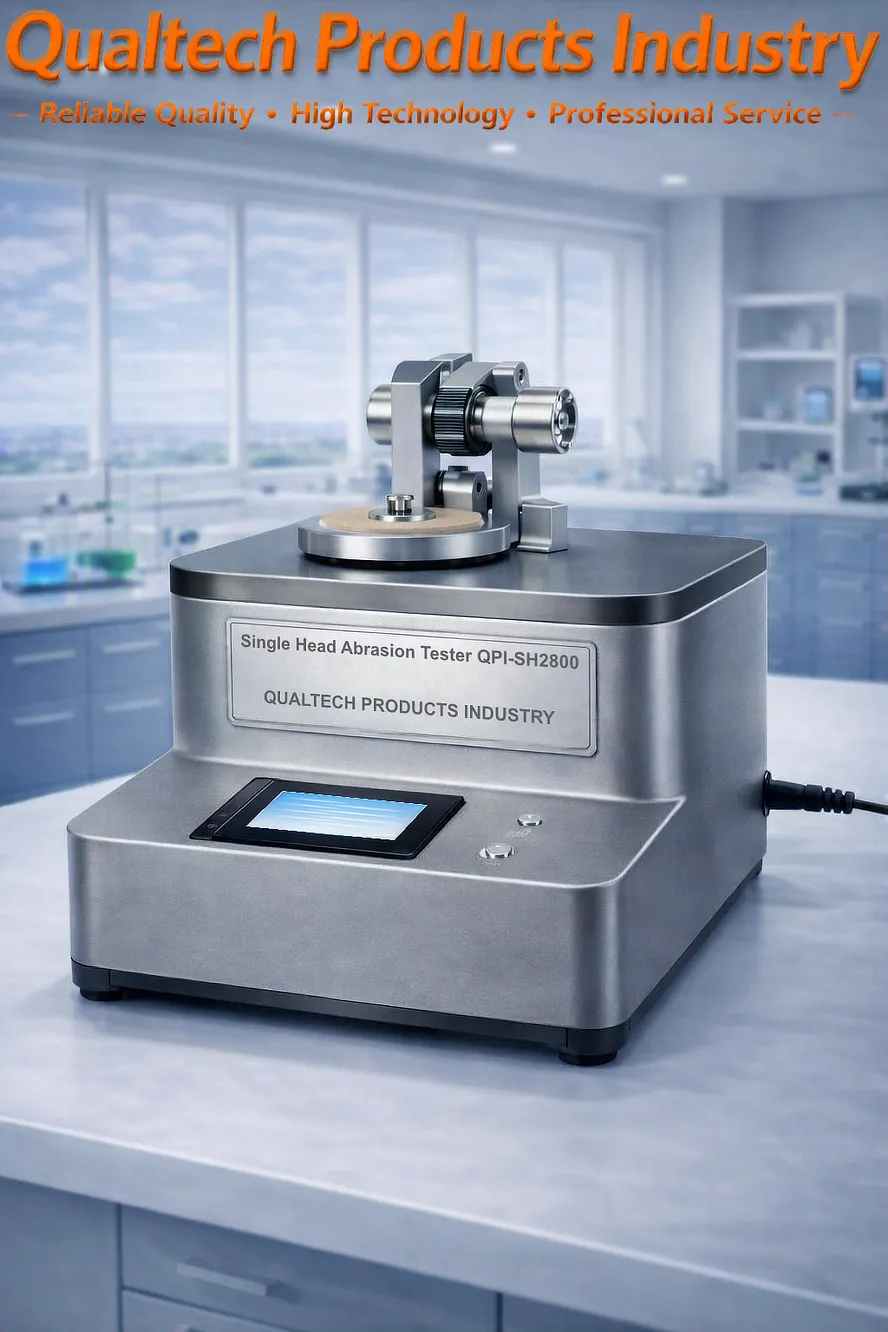
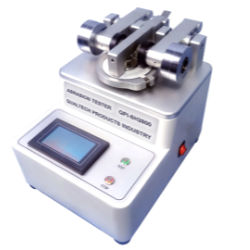
Qualtech Products Industry Single Platform Abrasion Tester is a precision Rotary Abrasion Tester to perform automatic Accelerated Wear Tests on samples and sample surfaces by abrasion to instantly determine the Resistance to Dry Abrasion at the touch of a button. The integrated large Color Touchscreen Display offers an intuitive and user-friendly Abrasion Test Experience.
This professional Rotary Platform Abrasion Tester is suitable for a wide range of samples, sample surfaces, surface coatings and protective surface coatings including solid samples, coated surfaces, protective lacquers, protective surface coatings, electroplated surfaces, plastic-coated surfaces, textiles, leather, rubber, linoleum, laminated floor tiles, wood panels, ceramic tiles, metals and many more.
The Test Method for Abrasion Resistance is performed by mounting a sample onto the Sample Platform. The Sample Platform is a turntable which rotates the sample at a specified speed. During the rotation the sample is in direct contact with two specified Abrasive Wheels with a specified Test Load to determine the Resistance to Wear of the sample. The Abrasive Wear Action is achieved with the two specified Abrasive Wheels rotating in opposite directions set and kept in motion by a the rotating Sample Platform. The Abrading Wheels travel on the sample surface following a horizontal axis displaced tangentially from the axis of the test material which results in a sliding action. An exclusive feature of this Test Method for Abrasion Resistance is the “X” Pattern of Abrasion established by the rub-wear action of the Abrasive Wheels.
The Rotary Abrasion Wear Pattern formed on the sample surface is that of two intersecting areas or a slightly curved herringbone configuration from the outside to the center and from the center to the outside. During the Abrasion Test the sample surface is subjected to wear and abrasion and the material surface is abraded at all angles of grain or weave.
This professional Automatic Single Platform Rotary Abrasion Tester is designed and engineered offering the newest microchip technology combined with a large Color Touchscreen Display, comfortable Sofftouch Buttons, an advanced Sample Turntable, Continuous Speed Control, advanced Constant Speed Technology, automatic Rotary Abrasion Test Programs, a wide range of available standardized and precision-engineered Abrasion Wheels, a wide range of standardized and carefully calibrated precision-engineered Test Loads, optional custom engineered Test Loads, an easy Sample Mount System, easy Abrasion Wheel Mount & Swap System, easy Test Load Mount & Swap System, advanced Platform Constant Speed Technology, Calibration Options, optional Vacuum System, user-friendly Menu Navigation, user-friendly Application, user-friendly Sample Handling, High Accuracy and High Precision, an ergonomic Design, reliable Performance and much more.
The large Color LCD Display presents the test data and the test details for an advanced and Automatic Sample Abrasion Resistance Test Analysis including the Sample Platform Speed, the number of completed Abrasion Cycles, the number of preset Target Abrasion Cycles and much more.
This professional Single Turntable Abrasion Tester is designed and engineered in accordance with international test standards including:
- ASTM C501 (Standard Test Method for Relative Resistance to Wear of Unglazed Ceramic Tile by the Taber Abraser)
- ASTM C1353 (Standard Test Method for Abrasion Resistance of Dimension Stone Subjected to Foot Traffic Using a Rotary Platform Abraser)
- ASTM D1044 (Standard Test Method for Resistance of Transparent Plastics to Surface Abrasion)
- ASTM D3884 (Standard Guide for Abrasion Resistance of Textile Fabrics (Rotary Platform, Double-Head Method))
- ASTM D3389 (Standard Test Method for Coated Fabrics Abrasion Resistance (Rotary Platform Abrader))
- ASTM D4060 (Standard Test Method for Abrasion Resistance of Organic Coatings by the Taber Abraser)
- ASTM D5034 (Standard Test Method for Breaking Strength and Elongation of Textile Fabrics (Grab Test))
- ASTM D5035 (Standard Test Method for Breaking Force and Elongation of Textile Fabrics (Strip Method))
- ASTM D7255 (Standard Test Method for Abrasion Resistance of Leather (Rotary Platform, Double-Head Method))
- ASTM D6037 (Standard Test Methods for Dry Abrasion Mar Resistance of High Gloss Coatings)
- ASTM D-7255 (Standard Test Method for Abrasion Resistance of Leather (Rotary Platform, Double-Head Method))
- ASTM F362 (Standard Test Method for Determining the Erasability of Inked Ribbons)
- ASTM F510 (Standard Test Method for Resistance to Abrasion of Resilient Floor Coverings Using an Abrader with a Grit Feed Method)
- ASTM F1478 (Standard Test Method for Determination of Abrasion Resistance of Images Produced from Copiers and Printers (Taber Method))
- ASTM F1978 (Standard Test Method for Measuring Abrasion Resistance of Metallic Thermal Spray Coatings by Using the Taber Abraser)
- DIN 52347 (Testing Of Glass And Plastics; Abrasion Test; Method Using Abrasion Wheels And Measurement Of Scattered Light)
- DIN 53109 (Testing Of Paper And Board – Determination Of Abrasion By The Abrasion Wheel Method)
- DIN 53754 (Testing Of Plastics; Determination Of Abrasion, Abrasive Disk Method)
- DIN 53799 (Decorative Laminated Sheets On Basis Of Aminoplastic Resins; Test Method)
- DIN 68861-2 (Furniture Surfaces – Part 2: Behavior At Abrasion)
- ISO 10074 (Anodizing of aluminium and its alloys — Specification for hard anodic oxidation coatings on aluminium and its alloys)
- ISO 14656 (Epoxy powder and sealing material for the coating of steel for the reinforcement of concrete)
- ISO 24338 (Laminate floor coverings — Determination of abrasion resistance)
- ISO 3537 (Road vehicles — Safety glazing materials — Mechanical tests)
- ISO 4586-2 (High-pressure decorative laminates (HPL, HPDL) — Sheets based on thermosetting resins (Usually called Laminates) — Part 2: Determination of properties)
- ISO 5470-1 Rubber- or plastics-coated fabrics — Determination of abrasion resistance — Part 1: Taber abrader
- ISO 7784-1 (Paints and varnishes — Determination of resistance to abrasion — Part 1: Method with abrasive-paper covered wheels and rotating test specimen)
- ISO 7784-2 (Paints and varnishes — Determination of resistance to abrasion — Part 2: Method with abrasive rubber wheels and rotating test specimen)
- ISO 9352 (Plastics — Determination of resistance to wear by abrasive wheels)
- ANSI INCITS 322-2008 (Information Technology – Card Durability Test Methods)
- AS/NZS 1580.403.2:1994 (Paints and related materials – Methods of test – – Abrasion resistance – Taber abraser))
- AS/NZS 4266.2 (Reconstituted wood-based panels – Methods of test – Dimensions, squareness, flatness and edge straightness of whole panel)
- EN 13329 (Laminate floor coverings. Specifications, requirements and test methods)
- EN 13523-16 (Coil coated metals. Test methods. Resistance to abrasion)
- EN 14323 (Wood-based panels. Melamine faced boards for interior uses. Test methods)
- EN 14327 (Leather. Physical and mechanical tests. Determination of abrasion resistance of automotive leather)
- EN 14354 (Wood-based panels. Wood veneer floor covering)
- EN 14431 (Vitreous and porcelain enamels. Characteristics of the enamel coatings applied to steel panels intended for architecture)
- EN 14688 (Sanitary appliances. Wash basins. Functional requirements and test methods)
- EN 14864 (Vitreous and porcelain enamels. Enamel coatings applied to steel for writing surfaces. Specification)
- EN 1504-2 (Products and systems for the protection and repair of concrete structures. Definitions, requirements, quality control and evaluation of conformity. Surface protection systems for concrete)
- EN 438-2 (High-pressure decorative laminates (HPL). Sheets based on thermosetting resins (usually called laminates). Determination of properties)
- EN 660-2 (Resilient floor coverings. Determination of wear resistance. Frick-Taber test)
- DD ENV 13696 (Wood and parquet flooring. Determination of elasticity and resistance to wear)
- FORD BN108-02 (Ford Laboratory Test Method – Resistance To Abrasion – Taber Abraser)
- HNEMA LD 3 (High-Pressure Decorative Laminates (HPDL))
- NF Q 03-055 (Paper And Board Tests – Determination Of Abrasion Resistance Of Paper And Board (by The Taber Method))
- SAE J 1530 (Test Method for Determining Resistance to Fiber Loss, Resistance to Abrasion and Bearding of Automotive Carpet Material)
- SAE J1847 (Abrasion Resistance Testing-Vehicle Exterior Graphics and Pin Striping)
- SAE J365 (Method of Testing Resistance to Scuffing of Trim Materials)
- SAE J948 (Test Method for Determining Resistance to Abrasion of Automotive Bodycloth, Vinyl, and Leather, and the Snagging of Automotive Bodycloth)
- TAPPI T476 (Abrasion loss of paper and paperboard (Taber-type method), Test Method TAPPI/ANSI T 476 om-11)
- UNE 135203-1:2010 (Road Signalisation Equipment – Horizontal Signalisation – Materials – Laboratory Abrasion Tests – Part 1: Determination Of The Abrasion Resistance By Taber Method)
- UNE48250 (Paints And Varnishes – Abrasion Resistance – Taber Method)
- UNE56842 (Kitchen Furniture – Tests For Surfacing Materials)
- UNE 56843 (Kitchen Furniture – Physical Tests)
- UNE56868 (Bathroom Furniture – Physical Test Methods)
- UNE 57095 (Paper And Cardboard – Determination Of Abrasion Strength (Taber Method))
- ECCA T16
- GM 9515P
- SIS SS923509
Rotary Abrasion Tester - Applications:
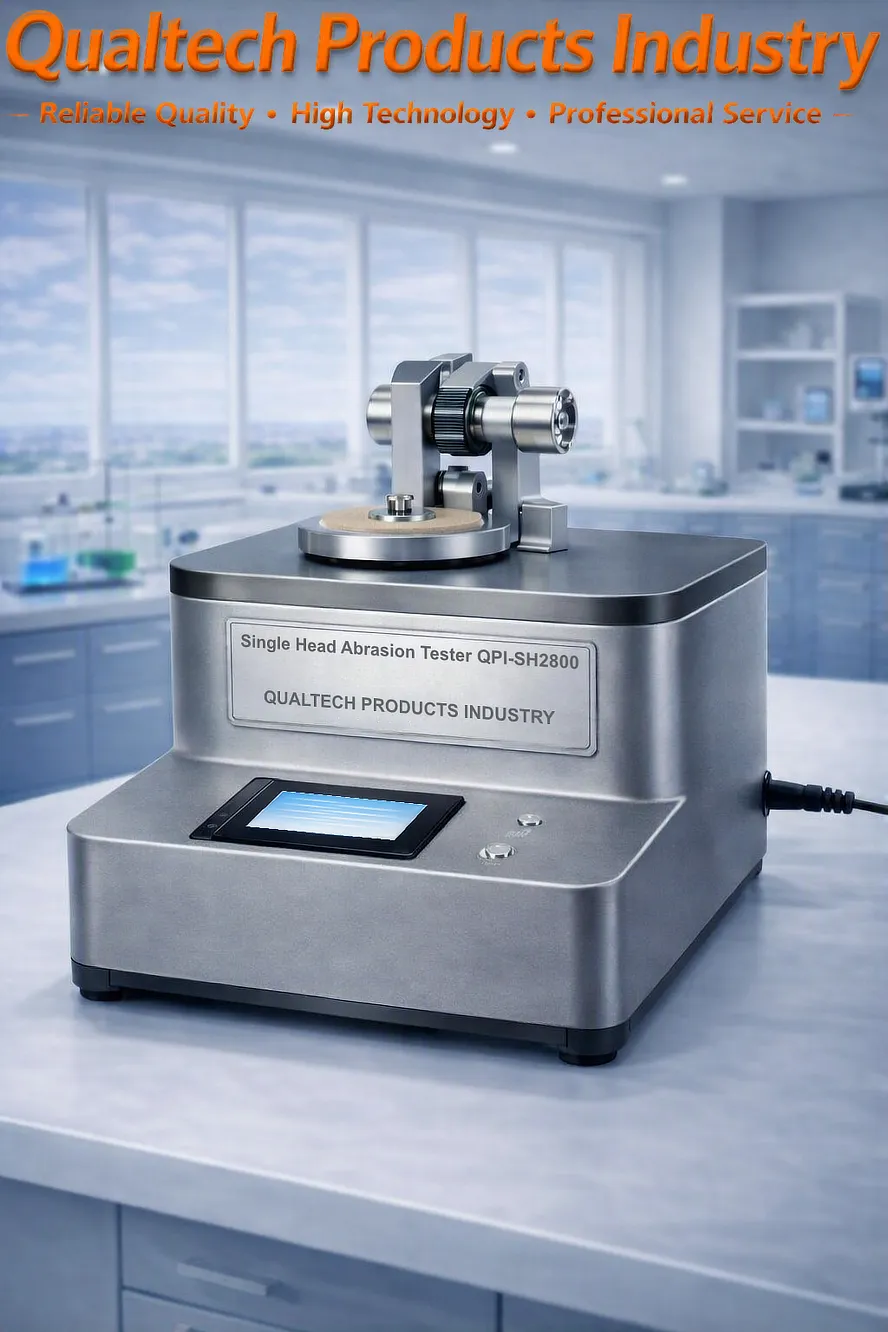
The Rotary Platform Abrasion Tester, commonly known as the Rotary Abraser or Rotary Abrader is a seminal instrument in material science and engineering for quantitatively assessing the resistance of surfaces to wear. Its principle provides an accelerated, standardized method to simulate long-term abrasive forces, yielding reliable data within minutes, a stark contrast to the extensive duration often required for in-situ field testing.
Test Method:
The core mechanism involves mounting a flat, circular or square specimen, typically 100mm in size with a central hole and up to 6.35mm thickness, though accessories allow for thicker materials, onto a rotating turntable. This turntable revolves on a vertical axis at a fixed, controlled speed of usually 60 or 72 revolutions per minute. Two specialized Abrasive Wheels are then precisely lowered onto the specimen's surface, applying a specified standard Test Loads of 250g, 500g and 1000g, optional auxilliary weights are available.
These Abrasive Wheels are driven by the rotating specimen itself, but crucially, they are mounted on horizontal axes that are tangentially displaced from the specimen's central axis. This unique configuration induces a characteristic "rub-wear" action: one wheel abrades the specimen outwards towards its periphery, while the other abrades inwards towards the center. The resulting abrasion pattern forms a series of crossed arcs within a circular band with a size of approximately 30 cm², ensuring that the material's abrasion resistance is evaluated across all angles relative to its weave, grain or orientation. A vacuum system is continuously engaged during the test to remove loose wear debris, preventing a 'three-body' abrasion effect that could skew results.
A critical feature of the Single Head Abraser is the use of reliable Abrading Wheels available in various grades with silicon carbide or aluminum oxide abrasives embedded in resilient or vitrified binders. These proprietary wheels are engineered to ensure continuous exposure of fresh abrasive particles as the binder material breaks down during use, maintaining consistent abrasive action throughout your sample tests.
Application in Research and Quality Management
This professional Single Head Abrasion Tester's robust methodology and widespread standardization including ASTM D4060 for organic coatings, ASTM D1044 for transparent plastics and ISO 9352 make this precision Single Platform Abrader indispensable across diverse industries for both fundamental research and stringent quality management.
1. Research & Development (R&D):
Material Science and Formulation Development: Engineers and chemists utilize this reliable Single Turntable Rotary Abraser to evaluate the intrinsic wear resistance of novel materials including polymers, composites, metals, ceramics and many more and optimize their formulations. By systematically varying components, curing conditions or processing parameters, engineers, researchers and scientists can quantify their impact on abrasion durability.
Coating and Surface Treatment Engineering: This professional Single Platform Abrasion Tester is paramount in developing and assessing new coatings including paints, lacquers, powder coats, electroplates, anodized layers, thermal sprays and many more designed for enhanced longevity and protective properties. R&D teams can screen potential coating systems, compare their performance under controlled abrasive stress, and correlate laboratory data with anticipated real-world wear mechanisms.
Wear Mechanism Analysis: Observing the wear patterns and debris generation allows researchers to infer underlying wear mechanisms including adhesion, abrasion and fatigue under controlled conditions. This informs the design of more durable materials and surfaces.
Accelerated Aging Studies: This precision Rotary Platform Abraser is frequently integrated into accelerated aging protocols. Materials or coatings can be subjected to environmental stressors, for example, UV exposure or chemical immersion prior to abrasion testing to assess the degradation of wear resistance over simulated service life.
2. Quality Management (QM) & Process Control:
Incoming Material Inspection: Companies utilize this reliable Turntable Abrasion Tester to verify that raw materials or pre-coated substrates meet specified abrasion resistance criteria before entering the manufacturing process, preventing downstream quality issues.
In-Process Quality Control: During production, this professional Single Platform Abrasion Tester serves as a critical test instrument for monitoring the consistency of manufacturing processes. Deviations in coating thickness, curing or material composition can be rapidly identified through changes in abrasion resistance, enabling timely corrective actions.
Product Performance Validation: For finished products this precision Single Head Rotary Abrasion Tester assists with validating performance claims related to durability and wear. This is crucial for products subjected to continuous handling, rubbing or contact, such as flooring, automotive interiors, consumer electronics, textiles and protective packaging.
Supplier Qualification and Benchmarking: Manufacturers can use standardized abrasion test data to objectively compare and qualify materials or components from different suppliers, ensuring consistent quality across the supply chain. It also facilitates benchmarking against industry standards or competitor products.
Failure Analysis: In cases of premature product failure due to wear, this Single Platform Abrader can be employed to replicate the observed wear patterns in a controlled environment, aiding in root cause analysis and the development of more robust solutions.
Metrics and Data Interpretation
Test results provided by this reliable Single Head Rotary Abrader are typically quantified using several key metrics:
Weight Loss: The most common method, measuring the mass of material removed in milligrams after a specified number of cycles.
Wear Index: Calculated as 1000 times the loss in weight in milligrams per cycle allowing for normalized comparison.
Depth of Wear: Measured using a thickness gauge or optical micrometer before and after testing to determine the reduction in material thickness.
Cycles to Failure: The number of abrasion cycles required to expose the substrate or achieve a specified degree of damage, for example, visual breakthrough, loss of functionality.
Visual Assessment: Subjective evaluation of the wear pattern, gloss reduction or color change after a set number of cycles often utilizing standardized grey scales.
This professional Rotary Platform Abrasion Tester remains an indispensable test instrument for engineers and scientists. Its ability to provide reproducible, quantifiable data on wear resistance under controlled conditions makes it a cornerstone for material innovation, product development and the meticulous assurance of quality and durability in diverse industrial applications.
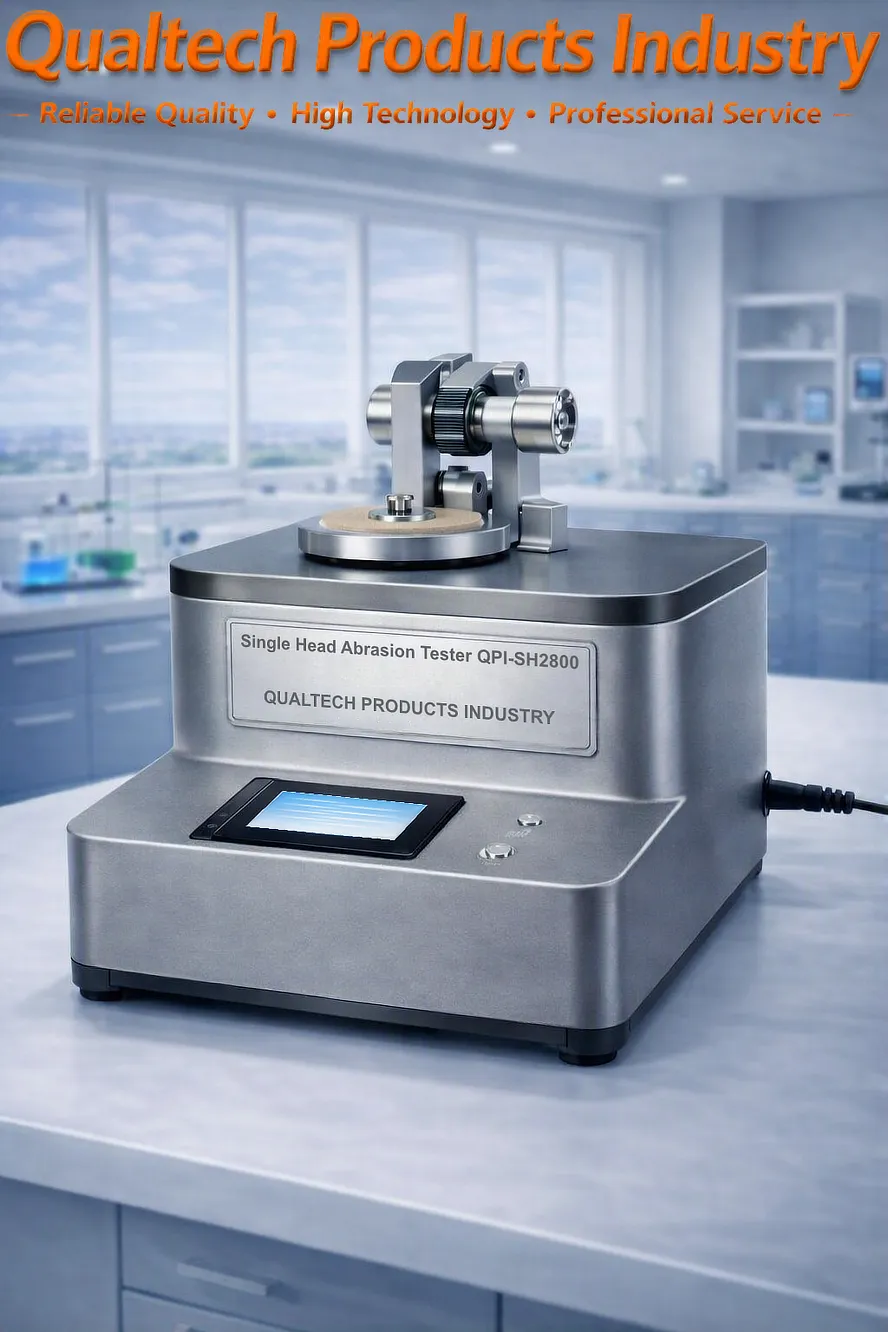
Single Head Rotary Abrasion Tester - Specifications:
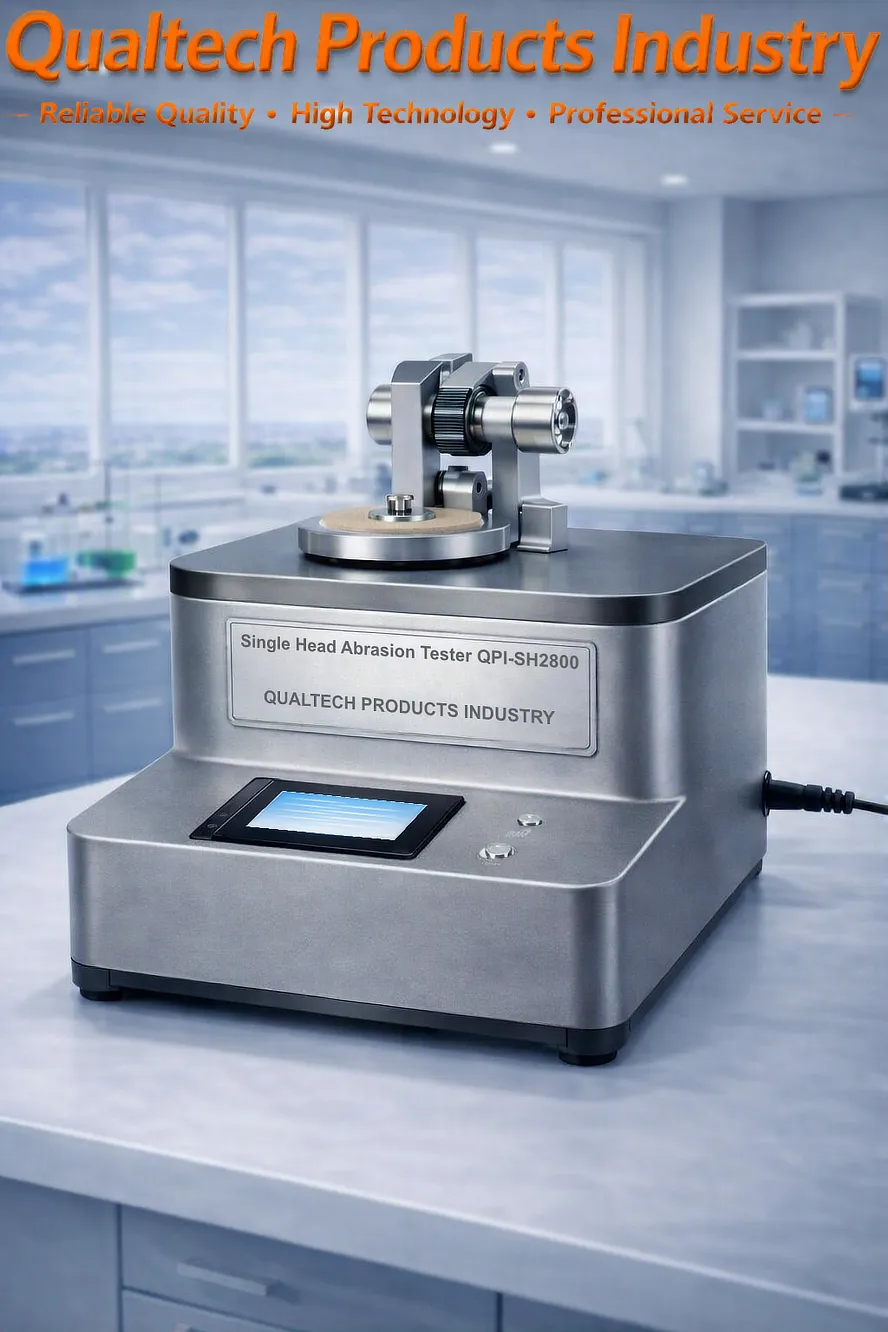
| Model | QPI-SH1800 | QPI-SH2800 |
|---|---|---|
| Newest Microchip Technology | Yes | Yes |
| Large Color Touchscreen Display | Yes | Yes |
| Comfortable Softtouch Buttons | Yes | Yes |
| Instant Automatic Abrasion Resistance Test | Yes | Yes |
| Test Specimen | Paint & Surface Coatings | Wood & Wooden Samples |
| Sample Speed | 60 RPM, 72 RPM & continuously adjustable | 60 RPM, 72 RPM & continuously adjustable |
| Carefully Calibrated Test Loads | 500g, 750g, 1000g | 500g, 750g, 1000g |
| Wide range of standardized and precision-engineered Abrasion Wheels | Yes | Yes |
| Optional custom engineered Abrasion Wheels available | Yes | Yes |
| Easy Sample Mount System | Yes | Yes |
| Included Solid Sample Holder | Yes | Yes |
| Optional Textile Sample Holder | Yes | Yes |
| Optional Vacuum System | Yes | Yes |
| Easy Abrasion Wheels Mount & Swap System | Yes | Yes |
| Easy Test Load Mount & Swap System | Yes | Yes |
| Advanced Sample Platform Constant Speed Technology | Yes | Yes |
| User-friendly Menu Navigation | Yes | Yes |
| User-friendly Application | Yes | Yes |
| User-friendly Sample Handling | Yes | Yes |
| High Accuracy & High Precision | Yes | Yes |
| Ergonomic Design & Reliable Performance | Yes | Yes |
| Voltage | 100VAC - 240VAC 50Hz/60Hz | 100VAC - 240VAC 50Hz/60Hz |
| Engineered in accordance with international test standards including ASTM D2486, ASTM D3450, ASTM D4213, ASTM D4752, ASTM D4828, ISO 11998, DIN 53778, BS 3900-F17, MIL-STD-1334 B, MIL-C-3004, MIL-C-46057, MIL-E-11237, MIL-P-15422 C | ||
Single Head Rotary Abrasion Tester – Included items:
- Automatic Single Head Rotary Abrasion Tester
- 2 Abrasion Wheels
- Standard Test Loads
- Optional Vacuum System
- Optional Glass Panels
- Solid Sample Mount
- Refacing Disks
- Additional Accessories
- Quality Certificate
- Carefully Calibrated
- Calibration Certificate
- User manual
- Extended Warranty
Get information now on products, pricing, technical support and professional services.
One of our specialists will reply to your enquiry shortly. Alternatively contact us via the company details in the USA, in Australia or in the UK.













 English
 Danish
 Dutch
Dutch Finnish
 French
 German
 Greek
Greek Irish
Irish Italian
 Luxembourgish
 Norwegian
 Norwegian
 Portuguese
 Scottish Gaelic
 Spanish
 Welsh
Welsh